 |
 |
 |
|
Immigration
Policy
Settling the West
| After Confederation in 1867, Canada’s immigration policy was greatly influenced by the government’s desire to develop and settle the western part of Canada. At that time, the map of Canada was very different from what it is now. Northern Ontario, Manitoba, Saskatchewan, Alberta, and British Columbia were all part of an area called the North-West Territories. They had not yet joined Canada. | 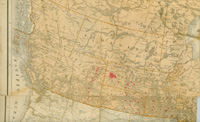 |
Click here to view another map of western Canada, ca. early-1900s
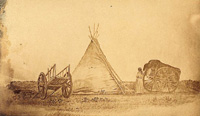
| In the North-West Territories there were a few small settlements. The largest of these were in the Red River Valley in Manitoba. Mostly, however, the prairies were inhabited by Aboriginal Peoples. Eastern provinces, such as Ontario and Quebec, were becoming overpopulated. Western Canada was viewed by the Canadian government as an ideal place to send this excess population. The government believed it needed to establish farming settlements throughout western Canada as quickly as possible. Then it would have a reason to build a railway network that would link Canada from coast to coast. It was hoped that this nation-wide railroad would cause Canada’s population to grow quickly. It would help the economy of the country to grow as well. The first step was to acquire the land that belonged to the Aboriginal Peoples. |  |
| The federal government wanted much of the land that Aboriginal peoples owned. It was successful in getting the Aboriginal Peoples to give up their rights to the best land in the prairies by convincing them to sign treaties. These treaties forced the Aboriginal Peoples to live on smaller, poorer pieces of land. In exchange the government promised to help Aboriginal peoples learn to farm successfully. Unfortunately, the Canadian government did not give the Aboriginal Peoples enough funding or training to successfully live an agricultural lifestyle. Instead, most of the government’s money was used to build the railroad. The money that Aboriginal Peoples were to receive was not given to them directly. It was given to agents to manage for them. The agents did not manage the money well. The Aboriginal Peoples’ situation only grew worse when the poor growing conditions in the 1880s led to deadly outbreaks of disease on reserves. | 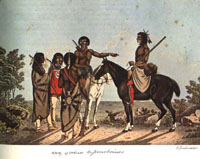 |
 |
| Many Métis people in Manitoba were also persuaded into moving farther west by the Roman Catholic Church. The church wanted to replace the Manitoba Métis with well-educated French-Canadians from eastern provinces who were more likely to practice French-Catholic traditions. These easterners, who came to live in the western prairies, regularly fought with the Métis. The Métis wanted to settle together in blocks of land. The Canadian government refused to allow the Métis to settle in groups of solely Métis. However, they did allow certain groups from Europe to do so. When this happened, the Métis people became dissatisfied with their treatment and many left Manitoba for Saskatchewan and Alberta. | ||
 |
 |
 |
Now the best land in the country belonged to the Canadian government
and it began to seek out the ideal immigrants who could develop this
land and contribute to Canadian society.


