 |
 |
 |
|
Immigration Policy
Clifford Sifton, Frank Oliver, and Changes to Immigration Policy
| After 1896, Canada’s immigration policy became increasingly difficult for immigrants. Under the new Minister of the Interior, Clifford Sifton, and his successor, Frank Oliver, the government tried to put restrictions on the people who wanted to come to Canada. | 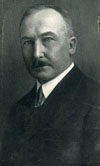 |
Canada’s first efforts to restrict immigration had started in 1872 when the government banned criminals and those people with a history of violence from entering the country. Canada’s immigration policy soon also banned the entry of sick immigrants or those of several racial minorities. In 1879, Canada prohibited the entry of poor or disabled immigrants. In 1885, the government made its first attempt at excluding a specific nationality when they imposed a tax on every Chinese immigrant wishing to enter Canada. This tax was called a “head tax”. From 1885 to 1914, Canada’s immigration decisions were based on the good health, positive attitude, wealth, and race of potential immigrants. Several nationalities, such as Asians and black Americans, were thought to be undesirable. They were discriminated against based on the belief that they would not adopt Canadian traditions and customs and blend into Canadian society easily. In other words, they were believed to be unable to fit in or be assimilated. They were considered to be inassimilable.
| Sifton believed that massive immigration of experienced farmers was crucial to Canada’s western development. When he took office in 1896, his belief led to Canada’s immigration policy becoming even more restrictive when he banned the entry of any immigrants who were not suited to a farming lifestyle. Sifton was successful in denying the entry of what he believed to be unwanted, inassimilable immigrants, such as Italians, Chinese, and African-Americans. He was able to do this not through changing the laws, but through informal, prejudiced choices on who could or could not enter the country. |
Click here to view a document outlining Canada's immigration policy towards Italians.
Oliver, who replaced Sifton in 1905, passed the Immigration Act in 1906. This Act combined the various existing immigration policies into one single piece of legislation. The Act formally identified several groups, such as the mentally challenged and the sick or impaired, as classes of people who were unacceptable as possible immigrants. Any immigrants living in Canada who became a “public nuisance” or were “undesirable”, such as those who became sick or went to prison, were deported back to their homelands. In 1910, the act became even more difficult for immigrants when the government was granted the right to deport immigrants that did not agree with the nation’s moral or political beliefs.
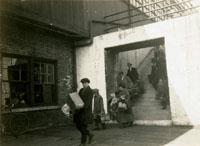
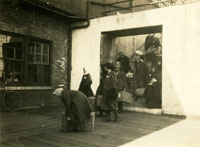
| In 1908, Oliver established border crossings at thirty-eight locations to process the traffic of Americans and Canadians across our shared border. The immigration service became much more functional under the leadership of Oliver. As a result, the number of immigrants coming to Canada boomed, despite the restrictive measures imposed on the admission of many nationalities and classes. | |
 |
 |
In
this period of time, the Canadian government’s immigration policy
was determined by two conflicting themes: one, that immigrants were
needed to develop the west and act as a source of labour, and two,
that it was reluctant to accept immigrants who spoke different languages,
practiced different customs, were less-educated, or had a different
skin colour. Many of the people willing to come to Canada to develop
the west and serve as a cheap source of labour were turned away by
immigration officials for prejudiced reasons.


